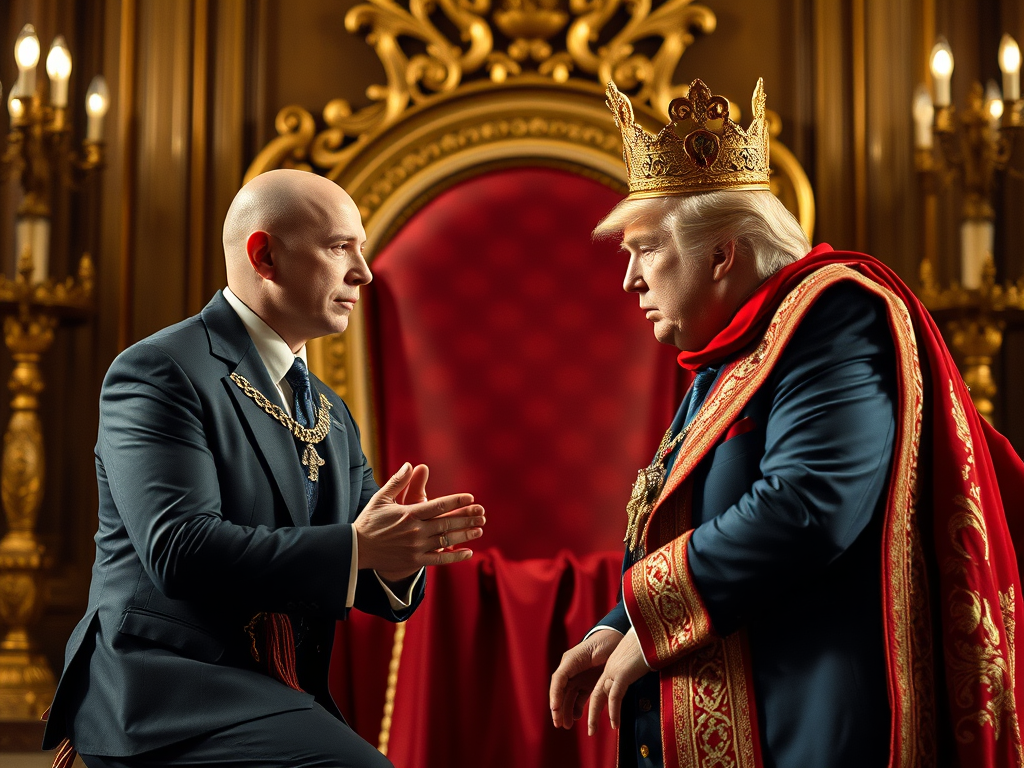
When listing tariff costs becomes a “hostile act,” you know the emperor’s narrative is cracking.
Amazon recently considered a simple act of transparency: listing tariffs as a separate line item on its low-cost “Haul” platform. You know, like letting customers see what they’re actually paying for. But immediately, the Trump White House called it a “hostile and political act.”
Let’s be clear: this wasn’t a policy debate. It was an authoritarian reflex. For Trump, even minor transparency is dangerous. It is especially risky when it exposes one of his longest-running lies: that “China is paying the tariffs.”
A Loyalty Test Disguised as Policy
Jeff Bezos, of all people, should’ve been safe. He donated to Trump’s inauguration. He showed up. The Washington Post even toned things down. But with Trump, loyalty doesn’t last. It’s not earned—it’s enforced. And Amazon crossed the line by flirting with the truth.
📌 Fact: Tariffs are taxes on U.S. importers. Not China. Not Xi Jinping. American businesses pay them, and then pass the costs down the chain—to you.
According to the Peterson Institute, Trump’s tariffs cost American households over $2,600 a year. Amazon sellers are already raising prices by 29%. And yet MAGA still cheers, clinging to a fantasy that’s never been backed by a shred of economic evidence.
The MAGA Fantasy Chain: A Story with a Price Tag
Trump’s version of economics runs on vibes, not data. “We’re taxing China!” sounds tough at a rally, but it wilts under the fluorescent lights of reality.
Tariffs are a tax on imported goods. U.S. companies pay them, then mark up their prices. The government doesn’t mail China a bill—despite what Facebook memes suggest.
And here’s the kicker: the Trump administration exempted politically sensitive goods like semiconductors and pharmaceuticals. If this was really about “fair trade,” why all the carve outs? Simple—this isn’t trade policy. It’s a racket.
📌 Historical reality: Trump’s tariffs didn’t reduce the trade deficit or bring jobs back. They brought inflation and supply chain chaos.
Trumpism ≠ Capitalism
There’s nothing capitalist about punishing your enemies and rewarding your friends.
Capitalism, in theory, is about innovation, competition, and wealth creation. But Trump’s approach is a toxic stew of mercantilism and strongman theatrics: centralized control, loyalty tests, and zero-sum thinking.
His proposed 2025 tariffs—10% across the board, up to 60% on Chinese goods—aren’t about strategy. They’re about optics. It’s not “reciprocity.” It’s revenge economics.
📌 As the Hoover Institution notes, this type of policy disrupts long-term growth and stability. Trumpism turns trade into performance art—with real costs for real people.
A Playbook for Breaking the Fantasy
Your book makes the case that political fan fiction—like “China pays the tariffs”—dies in the sunlight. So let’s shine some light.
🧾 Ask for Receipts.
If China’s footing the bill, show us the Treasury check. (Spoiler: they don’t exist.)
🤥 Highlight the Hypocrisy.
Tesla gets tariff exemptions. So do key pharmaceutical companies. MAGA’s “economic populism” works great—if you’ve got the right lobbyist.
🏢 Rally the Business Community.
Amazon blinked under pressure. But if more businesses start itemizing tariffs on receipts, the whole con becomes harder to sell. Imagine seeing “Trump’s China Tariff: $137.42” next to your kid’s new backpack.
Conclusion: Tear Down the Curtain
Trumpism survives on confusion. On blurred lines between fact and fiction. Tariffs are just one front in a larger war against accountability.
But when businesses call out the cost—literally and figuratively—we begin to unravel the illusion. We reassert what capitalism should be: a system that rewards value creation, not political flattery.
Transparency is the enemy of authoritarianism. And your work is helping bring the receipts.
📣 Call to Action:
If you run a business, start listing tariffs as a separate line item. Don’t let deception be a line in your ledger.
 Republican Fan Fiction
Leave a comment