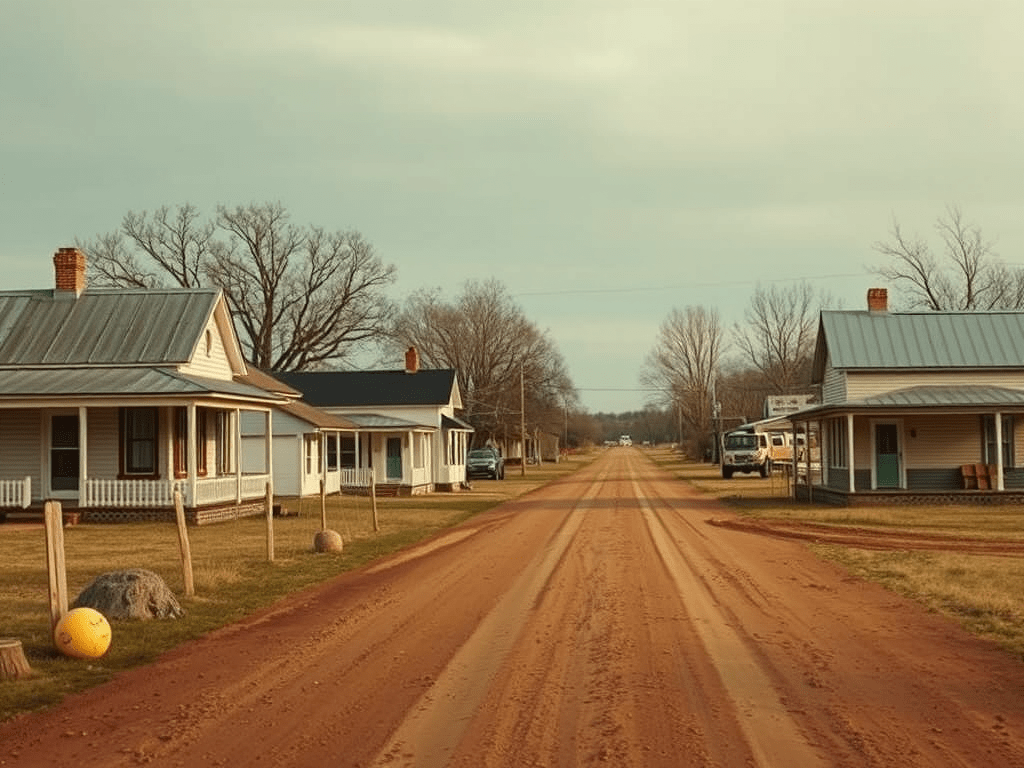
Not to brag, but I grew up in Pine Snag, Arkansas, in the 1980s—a place where the nearest town was an hour’s drive, and the phone line was a party line shared with half a dozen neighbors. We could eavesdrop on every conversation, which kept us plugged into the gossip loop and reminded us that privacy was a luxury we couldn’t afford. According to the old-timers, we were safe because we were white, and Pine Snag was ‘just us.’ But safety came with its own rules, its own hierarchy.
There was an unspoken caste system, invisible to outsiders but as real as the dirt roads that crisscrossed the county. Families were either ‘good,’ ‘okay,’ or ‘bad.’ The distinction wasn’t just about money or manners—it was about something deeper, something inherited. The ‘good’ families owned land whose deeds doubled as family trees, their roots tangled deep in Pine Snag’s soil. The ‘okay’ families owned land too, but they were new to the community—’new’ meaning first or second generation. The ‘bad’ families? They were everyone else. They didn’t belong, and they couldn’t be trusted. (If Pine Snag had a motto, it would’ve been: Know your place, or we’ll remind you.)
We had minority families move in and out of school. Most times, the community rejected them. They couldn’t find stable work. Sure, there were jobs, but not the kind that could sustain a family. Mostly, low-skill and low-wage jobs. When they tried something entrepreneurial, customers avoided them. The two exceptions were the families that owned the Chinese and Mexican restaurants—there was one of each. Even then, they were tolerated more than accepted, their businesses seen as necessary but not truly part of the community. (I guess tacos and egg rolls were the great equalizers.)
Crime was rare, but when it happened, it was always blamed on the ‘bad’ families, as if their blood carried a curse. I didn’t understand it then, but I knew it mattered. In Pine Snag, race mattered, followed by how long your family had been part of the community. If a kid from a ‘good’ or ‘okay’ family got into mischief with a kid from a ‘bad’ family, the authorities would often let the ‘good’ family handle their own. But the other kid? Not so much. Justice wasn’t blind in Pine Snag—it knew exactly who you were and where you stood.
And it wasn’t just the authorities. The teachers, too, played their part. They were the gatekeepers of the status quo, the ones who quietly reinforced the rules of the caste system. In their classrooms, the ‘good’ kids were praised, the ‘okay’ kids were tolerated, and the ‘bad’ kids were written off before they even had a chance. In school, I first realized that the world wasn’t fair—and that some people were determined to keep it that way.
Teachers told us we were lucky because we weren’t shuffled around like those kids in Little Rock. This was during the busing and desegregation days, and I remember a few teachers saying it made them sad, knowing the state was sending kids into violent situations. They claimed Little Rock was overrun with gangs, as if that justified keeping things the way they were in Pine Snag. More than once, a teacher pointed out a black kid in a textbook, saying it was because of the government and affirmative action. They’d explain, with a tone of resentment, that there was a quota—for every four or five “normal” people, there needed to be a bit of “color.” It was their way of teaching us that fairness was something forced, not earned. (Because, apparently, diversity was just a box to check, not a value to embrace.)
Even outside of school, the lessons of hierarchy and prejudice were everywhere. I remember grandparents and others saying, when negotiating, that they needed to “chew” someone down on price. As a kid, I thought it was a metaphor, implying that the price was being eaten away at. It wasn’t until college, when I saw the actual phrase written—”jewing them down”—that I understood what they really meant. It was a casual, unthinking bigotry, so ingrained that no one questioned it. And that, perhaps, was the most insidious part of growing up in Pine Snag: the way prejudice was woven into everyday life, invisible to those who didn’t know to look for it.
I would like to say Pine Snag and the rest of rural America have changed. They haven’t. I would like to think this was limited to the Bible Belt. It’s not. It’s nationwide. America has become a homogenous country in every way, including bigotry. (Turns out, ignorance is one of our most successful exports.)
The 2016 election helped me realize this. Being from the South, I was accustomed to the Rebel Flag being flown as a symbol of heritage. However, I witnessed this flag being flown in places like Idaho, which—last I checked—was not part of the Confederacy. (Maybe they missed that day in history class.)
I still have land in the rural Ozarks. When Trump won the first time, at least six people said the best thing about his victory was that we could use the n-word again. I would have dismissed this had it been just one person. It wasn’t just one, and they all said it proudly. With his second win, it appears they were right. (Progress, right? Just not the kind anyone should be proud of.)
There’s an axiom that a house divided can’t stand. I believe it. We will all suffer if people in power hold others down for a short-term, selfish game. The purpose of this book is to combat this. I believe that oppression shouldn’t be used as a competitive advantage in the job market. I think that America can do all the great things it promised—a melting pot, a place where dreams can come true for those willing to dream and work hard.
I will offer a unique framework for discussing racism, classism, and systemic inequality. It’s through the lens of the fantasy chain and its role in developing what I call “Republican Fan Fiction.” (Spoiler alert: It’s less Lord of the Rings and more Lord of the Lies.)
 Republican Fan Fiction
Leave a comment